
Data Quality Starts at the Front Door (But Doesn’t End There)

Why agencies that depend on transferred data need a multi-faceted quality approach.
By Angus Irvine, Senior Vice President, IdeaCrew
September 2026
Every public agency runs on data it did not create: from providers, from partner agencies, from other levels of government, from residents filling out forms. That data has to become reports the federal government will accept, decisions leadership can defend, and services that properly support the people who rely on them. When the data arriving at an agency’s door is incomplete or inconsistent, the agency inherits the problem, even though it did not cause it.
We see this to some degree in every engagement we run. It is not a sign that an agency is doing something wrong. It is what happens when data is produced by one system, under one set of rules, and then used by another.
A problem every agency inherits
In the state-based marketplaces we build and operate, it shows up most often in two places. The first is migration. When a state leaves HealthCare.gov to run its own marketplace, or moves from one marketplace platform to another, it begins with enrollment data that was shaped by a different system’s rules. That data has to support the new system from its first renewal cycle, with real families’ coverage depending on it, and there is very little time to fix it after cutover.
The second, longer term, challenge is account transfer, the exchange of applications between a marketplace and its state Medicaid agency. Both systems are doing their jobs correctly, but they serve different programs with different rules. Medicaid determines eligibility using households defined by who lives together and their familial relationships, while a marketplace works from the tax household. A person moving between programs can arrive with a household that does not line up, an identifier the receiving system does not recognize, or information that was optional on one side and required on the other.
The expensive default: clean it later
The common response is to accept everything and fix it downstream. Data lands in a warehouse, staff reconcile it after the fact, and reports go out with footnotes. The approach is understandable: it keeps data flowing and does not require anyone outside the agency to change how they work. But it is expensive. Every correction happens weeks or months after the record was created, by someone who was not there when it was created, often by contacting a submitter who has moved on to other work. And the cost is paid again every reporting cycle.
It is also about to get more expensive. Beginning with the 2028 coverage year, pre-enrollment verification will require marketplaces to verify most of a consumer’s information before subsidies begin. A mismatch that used to be resolved quietly after enrollment will instead stand between a family and their coverage. Problems that could once be cleaned up later will need to be caught at the start.
Validate at the door
The better starting point, wherever an agency has the standing to set the standard, is to move quality control to the point where data enters the system. The clearest example from our work is a data hub we built for a public behavioral health agency that oversees dozens of community providers delivering prevention, treatment, and recovery services. The engagement began as a modernization project: consolidate sources, build a hub, produce the federal reports. As we mapped what was arriving from providers, it became clear that the most valuable thing we could build was not a better place to store data, but a better way for it to come in.
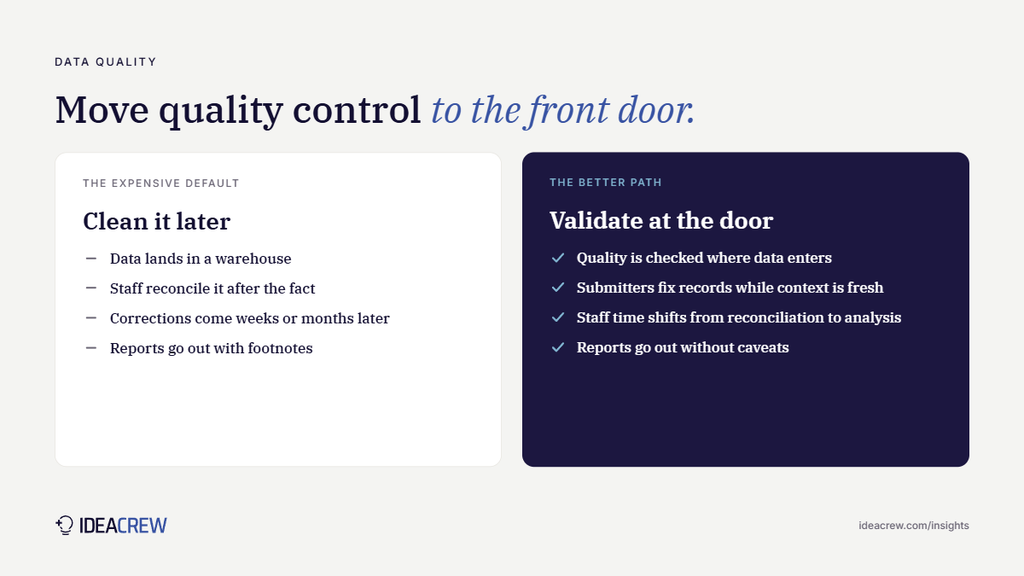
The centerpiece is a provider gateway, the single point where supplemental behavioral health data enters the system. It validates every submission against hundreds of criteria the moment it arrives and tells the provider immediately what passed and what did not. That one design decision does most of the work. A provider who gets feedback in real time fixes the record while the context is fresh. An agency that accepts data only once it meets its standards never has to reconcile a bad batch three months later. We also published a companion guide to the reporting rules for every provider, so the standards the gateway enforces are standards providers can build into their own systems and processes.
Behind the gateway, we reconciled tens of millions of Medicaid claim records, built dashboards for agency leadership, and developed a machine learning model that links client records held in separate systems into a single view. That last piece matters because whole-person care is a promise about people, not databases. Someone who receives services from three providers should appear in the agency’s data as one person.
When you can’t close the door
Validating at the door is where we start, and we hold to it wherever we can. It works when the agency sets the terms for what it will accept, as a behavioral health agency can with the providers it funds. But some data has to be accepted whatever state it arrives in.
Account transfer is the clearest case. A marketplace and a Medicaid agency are partners serving the same residents, often the same families. Neither can refuse the other’s data until it meets its own standards; a standoff between two agencies helps no one, least of all the person waiting on coverage.
For those sources, we use a different pattern: Stage and Verify. Records from a source the system must accept are checked against a relaxed set of intake rules, so they can come in. Any new record that falls short of the full standard is ‘staged’. It is in the system, and the person it belongs to can see it, but it cannot be used for any transaction until a user updates it, meaning it then passes the same validation as every other record. Updates to existing records work the same way – because the information in the system might be more accurate than the information arriving via account transfer, it is taken in, but does not update the source of truth until a user verifies it.
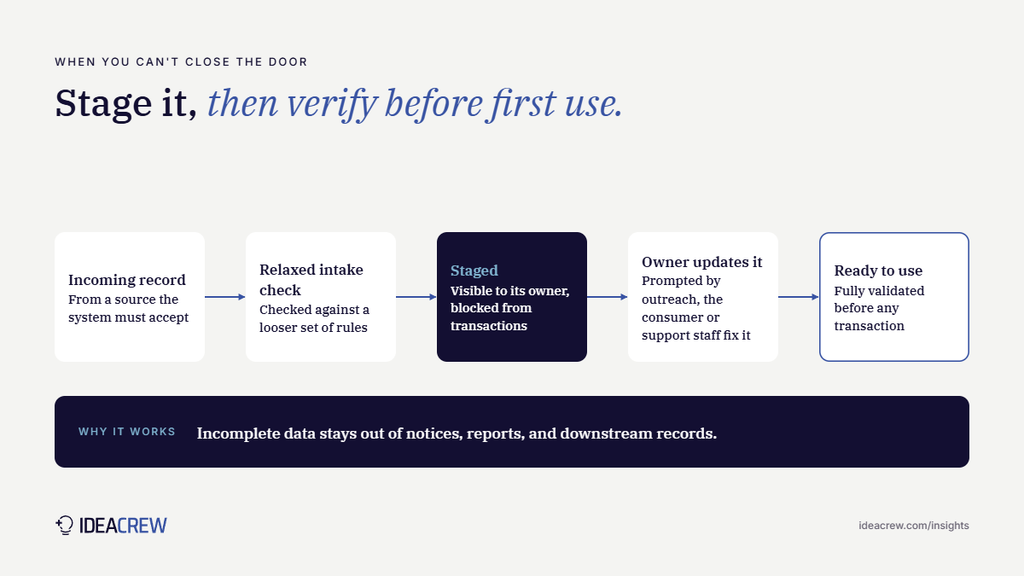
Stage and Verify does not wait for the consumer to stumble on the problem. When a record is staged for a person the system is seeing for the first time, automated outreach via noticing occurs, explaining what information is missing and how to fix it, so the correction happens well before a renewal or enrollment deadline. When the consumer logs in, whether to update their application, choose a plan, or report a change, the system applies the full rules and walks them through completing what is missing before they go further. A call center representative helping them over the phone works through the same prompts.
This does three things. It directs the cleanup effort to the people best placed to do it: the consumer who owns the information, or the support staff helping them, rather than back-office staff working from guesswork weeks later. It keeps incomplete data from spreading through the system into notices, reports, and downstream records. And it stops transactions from being built on top of bad data, so a small gap at intake does not compound into a larger problem at renewal or at tax time.
The two patterns share one principle. Quality is enforced at a deliberate point, by the people who can actually fix the data, before anyone relies on it.
What changes
When quality is enforced deliberately, whether at the door or before first use, an agency’s relationship with its data changes. Reports go out without caveats. Staff time shifts from reconciliation to analysis. Submitters get clear expectations and fast feedback, and error rates fall as they adjust.
Trust in data is the foundation of institutional confidence. It determines whether an agency can defend a funding request, respond to an oversight inquiry, or redesign a program to serve people better. Building that trust is less a technical achievement than an operational one that happens to need technology to carry it.
Why this matters to us
IdeaCrew is best known for the health insurance marketplaces we build and run in the District, Massachusetts, and Maine. That work taught us to operate systems where accuracy is a requirement rather than a feature, and where a bad record can mean a family loses coverage. The same discipline applies well beyond health insurance. Data integrity, governance, and analytics are challenges every public agency faces, whether it manages behavioral health providers, housing programs, or permit applications.
The lesson we carry forward is easy to say and hard to practice: if an agency cannot rely on the data it receives, do not start by building a place to put it. Decide where quality will be enforced. Where the agency can set the standard, hold it at the door. Where it cannot, let the data in, but do not let anyone act on it until it has been made right.
Sep 24, 2026