
Designing for Uncertainty
Background
The policy environment for agencies implementing federal policies and programs today is highly unpredictable. Delayed rule-making, court cases blocking policy change, and new initiatives announced with little notice can leave state agencies scrambling. Limited resources mean federal agencies may not be able to provide the kind of technical assistance that helps states make sense of the details
One example from our state-based marketplace clients highlights these challenges. People who get federal subsidies on the marketplaces are required to file a tax return and report their subsidies to support a process called reconciliation. Since their launch in 2014, marketplaces have been required to remove subsidies from households that failed to complete this reconciliation process.
Over the past decade, federal policy has changed around:
- How marketplaces should communicate with consumers as to why they were losing subsidies
- Whether the data provided by the IRS about reconciliation was accurate enough to enforce for a given year
- Whether subsidies should be removed after one year of not reconciling, or two
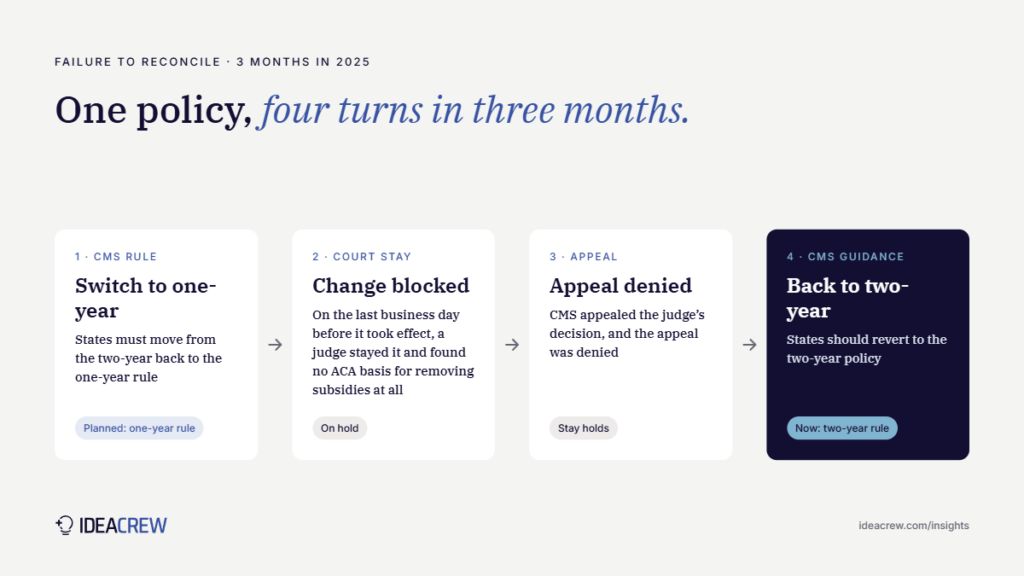
In just 3 months in 2025:
- CMS issued a rule requiring states to switch from the two-year back to the one-year rule
- On the last business day before the change was to go into effect, a judge not only stayed the change but also found that there was no basis in the ACA for removing subsidies at all.
- CMS appealed the judge’s decision, and their appeal was denied.
- CMS issued guidance stating that states should revert back to the two-year policy1
This kind of policy whiplash can leave product roadmaps and operational planning in tatters. But there are ways for state agencies and their technology partners to weather these policy storms. This article summarizes five ways to keep things on track with shifting policy winds.
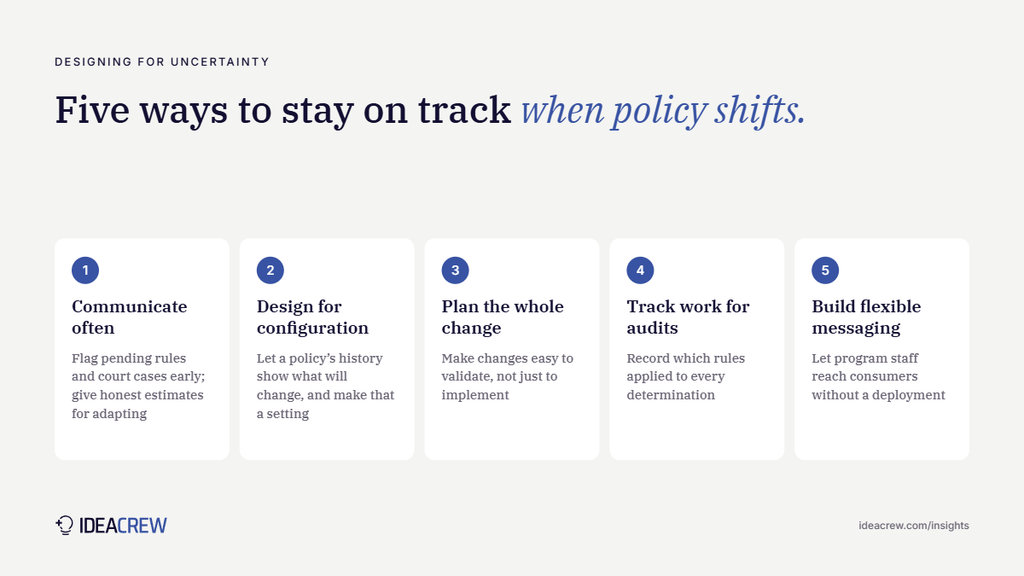
Recommendations:
- Maintain flexibility through frequent communication. A new regulation or court ruling may have immediate impacts on everything from a product roadmap to day-to-day operations. State agency staff can proactively communicate when there is uncertainty around a change (for example, if a court challenge is in progress), and delivery and operations teams can provide accurate estimates on the time it would take to safely adapt to a change. This helps everyone involved make contingency plans and move nimbly when change does occur. IdeaCrew partners with its clients to stay informed of federal rule changes and other factors like pending litigation.
- Design for easy configuration. Some regulations are subject to frequent change, while others go untouched for years. Taking the history of policy change into account when designing a product is key to positioning the agency to respond quickly. For example, knowing the frequent switches between one and two year failure to reconcile policies, IdeaCrew recommended a configuration to support both known and potential future changes.
- Keep the entire configuration change process in mind: Configuration changes must be easy not just to implement but also validate. In highly integrated operations like marketplaces that send and receive data from multiple trading partners and data services, scheduling and conducting end-to-end testing can become a barrier. Our team has built solutions to reduce our reliance on integration testing when all that is changing is our interpretation of responses we get from an integration partner. This approach has allowed IdeaCrew to implement changes quickly to meet critical business events, like redeterminations for Open Enrollment.
- Track your work to support future auditing: Sudden policy change can impact agencies for years afterwards. Programmatic audits are always at least a year (and usually more) behind, meaning agency staff are asked to account for eligibility determinations and process decisions made on a platform that is several versions behind the one they use day-to-day. Especially in areas where policy change is frequent and may fall mid-year, it’s important to make sure users can easily tell what set of rules was used to make a particular policy decision. For our failure to reconcile example, we make sure that each determination includes a full record of the configurations in place when that determination was made, while keeping access to the data used to make the determination accessible only by those with permission to access federal tax information.
- Build flexible communication tools: In a rapidly changing policy environment, program staff need to be able to communicate with consumers on short notice. Tools that allow designated program staff to publish ad hoc messaging themselves without requiring technical intervention or a system deployment are best.
For example, on our platform, our clients can do all of the following themselves – no engineer or deployment required:
- Post brief announcements that show up in members’ accounts on log in
- Send ad hoc messages to users’ account inboxes
- Update text of legal notices
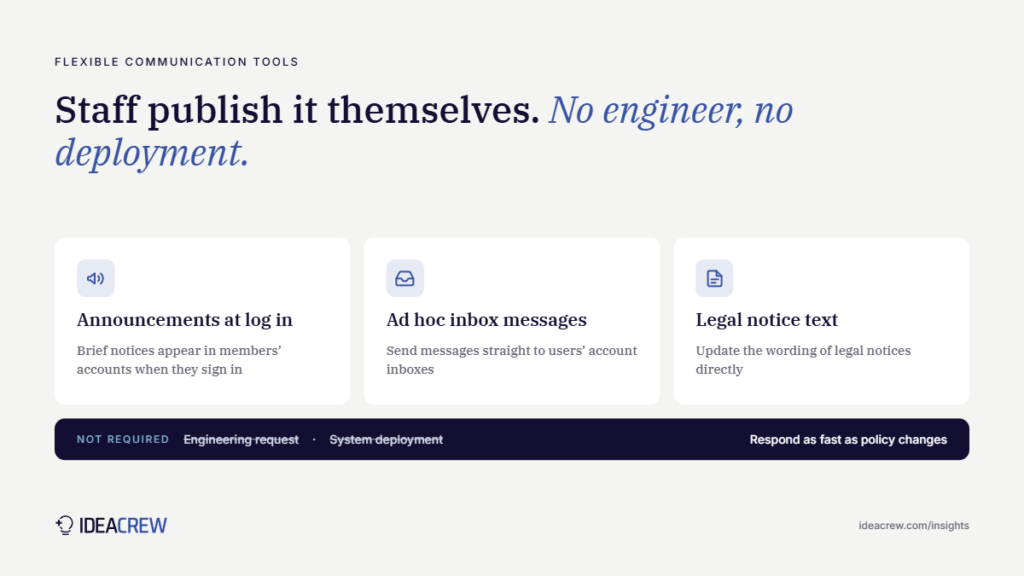
While a marketplace won’t be able to predict all the situations that require an urgent communication, having these tools allows them to respond as fast as possible.
Adapting to frequent policy change is difficult, but not impossible. Through close collaboration and thoughtful product and project design, state agencies and their technology partners can minimize disruption and stay focused on their program priorities.
Oct 15, 2026